

I’ve been contemplating what I wanted to write about this week since my Website Wednesday came and went without one word toward that day’s objective… A couple of things darted in and out of my mind on Wednesday, Thursday, Friday, but nothing stuck until I was taking my bath today.
I finished my third or fourth reading of “Invitation To Tea” this week, and I was surprised to come to the end of the book quite satisfied instead of yearning for more pages to read about Monica Lang’s life. I think it may have something to do with my age, or the fact that I really explored the world around her like never before with the aid of Google Maps and other online resources. None of those things were available the last times I read the book when my children were small. I really felt like I learned a lot this time, and I also found out that her book is actually considered a great historic resource that, though now in the Public Domain, should be preserved as a treasured snapshot of the world during the years she portrayed. She let us into her life growing up in a well-off and nurturing household in England at the turn of the century, becoming a woman away from her childhood home at a preparatory school, living a unique existence with the love of her life on a tea plantation in India, and experiencing the changes that took place in that region because of World War II. I guess it made me feel even more privileged to have been exposed to the book many years ago and, subsequently, to have met and conversed with her granddaughter at a quaint little tea party we arranged through a bookseller in Fullerton, California.
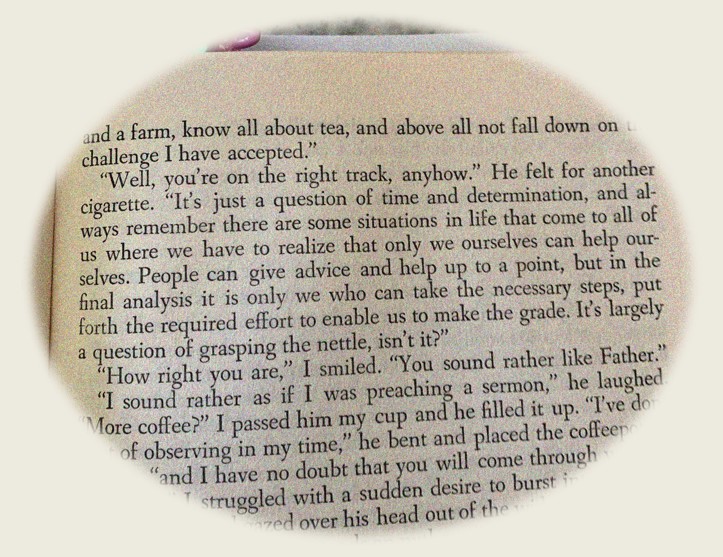
So I was reflecting on one of my favorite quotes in the book where the good doctor was advising Monica about successfully surviving (and thriving) in the lonely lifestyle she had chosen in the jungle of Assam, India:
One of the other things I was wanting to share this week was an article I wrote about my Dad. Today, I had this sort of epiphany about his story – like Monica’s story – illustrates decisions in life that define who a person becomes. Recently, Ray and I watched a movie about a successful golf team in California who experienced many obstacles and really never got a fair chance to compete merely because they were youth of Mexican heritage. I thought a lot about my Dad and the difficulties he must have faced as a Hispanic adolescent in Brea, California in that same timeframe. Maybe it gives me a better understanding of who he really was.
I was planning to add this reflection to my Rechelle’s Ruminations page, but it feels like the right way to end this blog post for today:
Reflection
My Dad was born in Mexico.
He was raised in a primarily white, middle class, neighborhood in Southern California.
I remember that he changed our last name when I was Middle School age, but I didn’t understand why.
When he passed away in the year my second child was born, I heard stories about how he did not want anyone to know of his Mexican heritage.
When he was a teenager, he went home every day after school and read the dictionary to learn definitions and proper pronunciation of the English language so that he would not be stereotyped along with the minority of Mexican teens around him.
He was a football star in high school, dressed nicely, worked to buy his own car at a young age, and was popular.
He went to college.
He changed our name.
He never taught me Spanish – even though he spoke it fluently.
He never shared his stories of his young years with me.
I finally got to learn about his story at the preparations for his funeral.
I didn’t consider myself to be anything but American until after my Dad passed away. I was an adult, with children of my own, and I heard some of my acquaintances make racial slurs that disparaged my heritage. They didn’t realize, but I finally felt a little of the dissention that comes from prejudice.
Maybe I got a glimpse into what motivated my Dad, but I’ll never know for sure.


 rechelle's lifelyrics
Leave a reply to Jim Rios Lacey-Baker Cancel reply